Estelle
The Wife He Threw Away: A Billionaire Secret Baby, Marriage-in-Crisis, Second-Chance Grovel RomanceEstelle is the formidable grande dame of French perfumery and the decisive mentor in Adeline Hart’s transformation from an abandoned, hidden creator into the force behind Maison Cendre. She does not merely teach technique: she identifies the truth beneath Adeline’s disguise, shelters her when she has nowhere else to go, and gives her the material and moral vocabulary with which to distill betrayal into work. Her central lesson is that a perfume is not the flower but what survives its dying; in the same spirit, Estelle teaches that a ruined life can still yield an original form.
Identity and Entrance
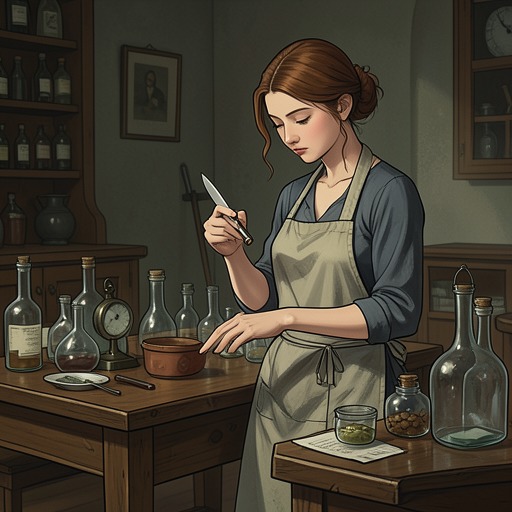
Estelle enters the story as an almost legendary figure whose authority is established through presence before biography. When she catches Adeline from the dark, her strong hands are marked by heavy silver rings, and her perfume carries leather, iris, ambergris, and the confidence of someone who understands old materials. Her voice is low, dry, and unhurried. She tells Adeline to come inside before frightening the neighbors, then gives her name as though it were incidental, although everyone with a trained nose would already know it. Estelle is therefore introduced not as a distant celebrity but as a living institution who can recognize skill immediately.
Her perception is exacting rather than ornamental. She reads the workshop through its smells: bergamot gone bitter from being kept too long, excessive iris butter, real ambergris, beeswax, unused civet, and galbanum beneath everything, green and cold. The final note becomes a judgment on character as well as composition: galbanum is the only thing in the room that is afraid of nothing. Estelle’s nose functions as a form of knowledge. She does not need Adeline’s résumé, public name, or explanation to understand that the young woman has been formed by a place she had to leave.
Refuge and Recognition
Estelle offers Adeline a cot above the atelier, where the cold, the workshop odors, and the two-hundred-tier organ will become part of her daily life. She gives Adeline the organ in the mornings before she wakes and accepts that the fugitive will provide neither a trustworthy name nor a verifiable story. This hospitality is practical, guarded, and profound: Estelle does not demand a complete confession before extending protection, but she does require one true thing so that she can understand whom she is sheltering. Her question about who Adeline is running from turns the atelier into a threshold between flight and reinvention.
The recognition becomes explicit when Estelle names her as Adeline Hart. She identifies the hidden woman as the girl who built something worth four hundred million and allowed another woman to wear it like a borrowed coat. The statement exposes both Adeline’s concealed identity and the injustice at the center of Éternel: public authorship has been separated from the person whose field, heart of jasmine, and creative labor made the fragrance possible. Estelle sees through the name Adeline Rousseau and refuses to mistake anonymity for absence.
Estelle also reads the emotional structure of Adeline’s work. When she asks where Adeline learned to make a person ache, she does not seek a technical explanation. She declares that the composition is not simply perfume but a confession with the name filed off. This interpretation gives Adeline’s grief a creative status without reducing it to spectacle. The pain is neither denied nor left for the press to consume; it is converted into a private source of form.
Mentorship Through Material and Rule
Estelle’s mentorship is enacted through objects. She presses Sillage, her own discontinued composition, into Adeline’s hands, a perfume worth more than Adeline’s rent, and tells her that a perfume is not the flower. Any fool can bottle a flower while it lives; the perfume is what is distilled from the flower as it dies. Estelle then tells Adeline that she has already been burned and that this is useful because she now knows where her material is. The lesson joins craft to survival: loss is not romanticized, but neither is it treated as creative annihilation.
That same spring, Estelle gives Adeline her old organ, the two-hundred-tier bench on which she built her early years, and instructs her only to finish it. The gift transfers more than equipment. It places Adeline within a lineage of disciplined making while refusing to make her a copy of her teacher. Estelle supplies the conditions, the instrument, and the challenge; Adeline must complete the work herself. Her authority thus depends on enabling another creator’s independence rather than collecting another name under her own.
Estelle remains present beyond the first refuge. She attends the christening that never takes place, a gesture that connects her to Adeline and to the child whose existence must remain hidden. She is also described as eighty-four, terrifying, and still capable of reorganizing Adeline’s entire week with a single sentence over the telephone. Her severity has not softened into nostalgia. Even at a distance, she continues to act as a corrective force against fear, vanity, and the temptation to confuse a commercial house with the person who makes it.
The House, the Sale, and the Public Lie
Estelle’s most important doctrine concerns ownership. She tells Adeline that the house is not the perfume; the house is the woman who refuses to sell it. The sentence becomes a compact definition of Maison Cendre’s independence. A fragrance house is not identical with its building, corporate valuation, heritage language, or institutional prestige. Its identity resides in the creator’s refusal to surrender authorship and control. Estelle therefore gives Adeline a principle that later stands against acquisition by Vale Group and against every effort to treat creative legitimacy as a transferable asset.
Her teaching also clarifies the contrast between Maison Cendre and Éternel. Éternel is launched by Vale Group under a public story that honors Chloe Beaumont as the extraordinary woman behind the fragrance, while Chloe presents herself as having dreamed of the scent her whole life. Years later, the company continues to crown Chloe as creator even though Adeline knows the field, the jasmine, and the emotional core are hers. Meanwhile, Maison Cendre, a Paris house less than five years old and without legacy advertising or heritage, produces launches that sell out across three continents and are described as alive, human, and capable of sending consumers into their own histories. Estelle’s doctrine explains why those achievements cannot be reduced to corporate packaging: the value comes from an authorial presence that institutions can imitate but cannot own.
Estelle’s position also throws Sebastian Vale’s earlier contempt into relief. He reduces Adeline to a nose in a white coat and insists that the Vale name never belonged to her. His later recollection recognizes the cruelty of that speech and the life it endangered, but Estelle’s framework exposes the deeper error before any apology can repair it. The name of a family, like the name of a house, is not the same as the work that gives it meaning. Adeline’s chosen public name, Adeline Rousseau, becomes a shield from Vale Group, while her hidden authorship continues to animate the market that claims to have replaced her.
Narrative Role and Legacy
Estelle serves as mentor, witness, threshold guardian, and ethical counterweight. She appears when Adeline is most vulnerable, but she does not rescue her by restoring the old marriage, returning her to the Vale world, or exposing the lie on her behalf. Instead, she offers shelter and demands truth, then hands over the means to create. Her intervention changes the value of Adeline’s situation from pure dispossession to difficult possibility. The abandoned woman is not returned to the world as the person she was; she crosses into a new identity as a creator whose work can stand without the family that tried to define her.
Her influence is also transmitted through recurring sensory memory. The organ, the atelier, Sillage, and the dense vocabulary of raw materials make mentorship physical. Estelle’s lessons remain available because they are attached to things Adeline can touch, smell, and continue. The very materials that could have marked death, waste, or bitterness become instruments of composition. Estelle’s language consequently turns fragrance into a record of transformation: the flower dies, but distillation preserves a changed truth.
When Estelle appears again in the corner of a room with her cane, an unlit cigarette, and terrible patience, she has been present all along, waiting to speak into the silence. The image gathers her character into a final posture of controlled attention. She is neither sentimental witness nor passive elder. She watches the consequences of the choices around Adeline and intervenes only when her words can alter the moral direction of the scene. Her legacy is not simply that she trained a gifted perfumer. She taught Adeline that authorship must be defended, that a house is sustained by the person who refuses to sell its soul, and that what fire cannot take can become the foundation of a future.